By Kazuzo Kudo, Kodokan Judo 9th dan
Advance-retreat (shintai) Under this single heading we include both the advance-retreat (shintai) type of movement and turning movements (tai-sabaki). Advance-retreat movements, as goes without saying, are the vital fundamental movements that let you move your body straight forward, backward, left or right to get it into the required position. If the ways you move your feet and body are correct and if they agree with the various postures and methods of standing with your opponent, when these movements appear in a technique, that technique will be correct and free of strain. To master the advance-retreat style of movement you must first master the following way of walking. Usually humans walk by putting their weight on one foot and advancing the other, then shifting their weight to the advanced foot as soon as it touches the floor and advancing the other foot. If we walk backwards the process is the same, only in the opposite direction. Forwards or backwards, this walking method always leaves your weight on one foot for an interval during which your body itself remains back with that support foot. In judo walking methods, on the other hand, we move our legs, hips, and bodies forward or backward all at the same time. For judo purposes, you must not put one foot forward and leave your body behind or advance your body and leave one foot behind. How to master this walking method? The first thing to remember is to maintain the natural body position. Earlier when we explained the natural position we said that you should not let your weight fall on only one or the other of your feet. This applies not only to standing perfectly still but to walking as well. In other words, in judo we walk in the natural position, or to put it slightly differently we walk with our hips. As you walk do not let your feet move too far apart or too close together, do not let your body—head, shoulders, hips—rise and fall, and walk in a sliding smooth fashion across the floor. Once you have mastered this walk, go on to learn the tsugi-ashi method. In ordinary walking we take a step forward on, say, our left foot, then bring our right foot forward one step farther than the position of our left foot and repeat this process over and over. In the tsugi-ashi method, however, beginning from the right natural position, we take a step forward on our right foot then bring our left foot forward far enough so that our body remains in the right natural position. In other words our left- foot does not move out in front of our right foot. It more or less follows it. The name tsugi-ashi literally means following feet. When we take tsugi-ashi steps backward from the right natural position we draw our feet back left right then left right again. When we advance from the left natural position we move left right then leti right, when we move backward we draw our feet back right left then right left. You should practice moving front and back in the tsugi-ashi style and taking four or five tsugi-ashi steps to your right and left sides. When you do, remember to constantly maintain the natural position, just as you do when you move forward and backward. At the risk of laboring a point, I want to take this chance to reemphasize the vital importance of maintaining the natural position which puts you in a posture and attitude to immediately respond to any move your opponent makes. Movement control (tai-sabaki) The Japanese words tai-sabaki are capable of two interpretations. In the wider sense they simply mean all natural body movements including the tsugi-ashi advance-retreat motions we have just been explaining. In the narrower sense they indicate the ways we manipulate and control our body's motions. We will be using them in the latter sense. Movement control involves the following six categories: 1. Carriage of the head You should always carry your head so that you feel that it rests not so much on your shoulders as firmly on your hip region. 2. Use of the eyes We should mention the importance of keeping your eyes slightly more narrowed than you do ordinarily. If we talk in camera terms we can compare this to narrowing the diaphragm to bring the subject in more clearly. In addition, since the eyes reveal the movements we intend to make, narrowing them prevents our opponent from being able to tell what we are going to do. Conversely, if you want to know what your opponent is up to, read it in his eyes. 3. Breath control If your breath is disorderly you will be spiritually agitated and unable to make accurate judgements. This means, of course, that your techniques will not have the effect they should. In free-style fights or in a match, if you feel your breathing is getting out of order, step away from your opponent, take a deep breath, and restore calm to your spirit by stabilizing your breathing. Once you have calmed down, maintain that calm by tensing your abdomen and concentrating your strength there. 4. Use of your torso By this we mean, in general, the way you handle your upper body. For instance you can twist it, bend it forward, or lean it backward to escape your opponent's attack or use the same kinds of movements in your own attack on your opponent. 5. Hand movements By this we mean the way you use your hands in general, the way you shake them, hold them, push with them, and pull with them. (Arm movement is included in the meaning of hand movement.) Though when your opponent grabs your wrist you will use a simple hand movement in releasing your hand by getting either a natural or a reverse hold on his hand, as your defenses and attacks increase in complexity, so, of course, will the hand movements you use. 6. Foot movements Naturally, the advance-retreat movements and all of the other foot actions, the way you advance your feet, the way you swing them around, clipping, sweeping, hooking movements, and all the others are performed in conjunction with the movements of the rest of your body.
If your technique does not work or if you cannot escape from your opponent, something in your body control is out of harmony. An imbalance exists somewhere. In cases like this, make a check of all six of these bodily control elements and the way you are handling them, and you will immediately find the cause of your mistake. For instance, if your opponent tries a right uchimata on you, you try to get away by lowering your head, but it does not work, and he throws you anyway. What went wrong? Think back over what you did, and you will say to yourself, "I've got it! First of all, the way I held my head was bad." You will immediately see that in this instance your head and body action should have worked together, that you should have snapped your head back and to the right as you ruined the pull of your opponent's left hand with your own left hand. |
|
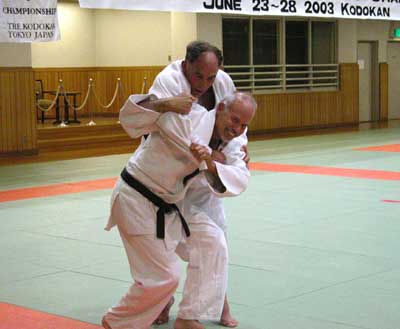 Whenever you are attempting a technique yourself or trying to get away from one of your opponent's remember that you must use the body movements made up of these six elements plus the proper posturing, method of standing with your opponent, advance-retreat movements, and the way you apply your strength in perfect coordination and as a connected action. Only when you can manage to do that will your techniques be as fine as they should.