by Neil Ohlenkamp The Kodokan emblem is seen very often by people practicing Judo and many have asked what it represents. Since the Kodokan is the original school of Judo founded by Jigoro Kano and still the international technical authority for Judo, its symbol is found in many dojos, books, web pages, and even on judogi. The symbol can be displayed with or without the Japanese characters for ju (gentleness, softness, yielding, or flexibility) and do (way, road, path, or teaching) as shown here. The Kodokan emblem is seen very often by people practicing Judo and many have asked what it represents. Since the Kodokan is the original school of Judo founded by Jigoro Kano and still the international technical authority for Judo, its symbol is found in many dojos, books, web pages, and even on judogi. The symbol can be displayed with or without the Japanese characters for ju (gentleness, softness, yielding, or flexibility) and do (way, road, path, or teaching) as shown here.
The cherry blossom was considered an especially beautiful and important symbol for Japanese samurai because at the height of its beauty it would inevitably fall to the ground to die. Samurai also had to be willing to sacrifice themselves in their prime, and the cherry blossom was evidence that this is the natural way of things and could even be beautiful and pure. Life is as delicate and light as the falling petals, and there is a natural time for all beautiful things to end. The samurai strove to understand the nature of life and death by meditating on the blossom of the cherry tree. This peace was tempered by the inner strength, power, and fighting spirit represented by the circle of red. Through the study of attack and defense in Judo we learn to harmonize our spirit and body, learning to both fight hard and let go softly.  In Eugen Herrigel’s “Zen in the Art of Archery” (1953) it is said that “It is not for nothing that the Samurai have chosen for their truest symbol the fragile cherry blossom. Like a petal dropping in the morning sunlight and floating serenely to earth, so must the fearless detach himself from life, silent and inwardly unmoved.” This may have been the motivation for the following interpretation of the Kodokan symbol which was widely accepted in the west. In Eugen Herrigel’s “Zen in the Art of Archery” (1953) it is said that “It is not for nothing that the Samurai have chosen for their truest symbol the fragile cherry blossom. Like a petal dropping in the morning sunlight and floating serenely to earth, so must the fearless detach himself from life, silent and inwardly unmoved.” This may have been the motivation for the following interpretation of the Kodokan symbol which was widely accepted in the west.
The standard emblem of the Kodokan is an 8 petaled flower of the cherry tree. It was adopted by feudal Samurai because the flower is detached from the branch at the apogee of its beauty in order to die. It symbolizes a degree of maturity within the individual which is summarized by the expression, “Strong within, but gentle without.” The fire red color of the center of the emblem indicates the “fire” or “ardor” of the individual. The spirit of the Kodokan combines the strength of iron forged to red heat inside the silk, supple, and white flower. This is symbolic of the union of body strength and resistant suppleness and flexibility of the pure spirit developed by the Judo exponent of black belt grade. It is a sign of personal attainment.
Judo Training Methods by Takahiko Ishikawa and Donn F. Draeger
 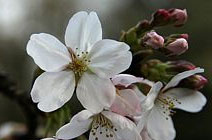 Although this is the most widely-publicized interpretation of the Kodokan symbol in the west, it is not the most accurate account. A cherry blossom (sakurabana) in Japanese crests is always represented with five petals, as shown in this symbol and photo of a cherry blossom. By contrast, the Kodokan emblem has eight pointed lobes. Some judo clubs and organisations have used the five-lobed cherry as part of their emblems, and as a meaningful Samurai symbol it is also accepted. But the Kodokan symbol has different origins. The colors in the symbol worn by members of the Kodokan represents a piece of red hot iron surrounded by pure white floss silk — hard in the centre, soft on the outside. The badge emphasizes the judo principle that the soft controls the hard, or gentleness can control force, that one can win by using the opponent’s force against himself. Although this is the most widely-publicized interpretation of the Kodokan symbol in the west, it is not the most accurate account. A cherry blossom (sakurabana) in Japanese crests is always represented with five petals, as shown in this symbol and photo of a cherry blossom. By contrast, the Kodokan emblem has eight pointed lobes. Some judo clubs and organisations have used the five-lobed cherry as part of their emblems, and as a meaningful Samurai symbol it is also accepted. But the Kodokan symbol has different origins. The colors in the symbol worn by members of the Kodokan represents a piece of red hot iron surrounded by pure white floss silk — hard in the centre, soft on the outside. The badge emphasizes the judo principle that the soft controls the hard, or gentleness can control force, that one can win by using the opponent’s force against himself.
The Kodokan symbol was not used until after Jigoro Kano died, so he may not have been involved in selecting it. A small pamphlet purportedly published by the Kodokan explained that the current Kodokan symbol was introduced in October 1940, and that the form is modeled after an ancient 8-sided copper mirror (called yata-no-kagami). This mirror is chronicled in Japanese Shinto legends and the shape is represented in numerous Japanese crests (mon). The mirror, reflecting everything truthfully, is a symbol for honesty. The red circle in the center was intended to symbolize a sincere and passionate mind. This historical account is now accepted as the authentic origin of the Kodokan symbol, and it has been confirmed by the Kodokan (Naoki Murata, director of the Kodokan Museum). The Kodokan symbol is the representation of Yata no Kagami, or “The Mirror Yata” or “The Octagonal Mirror”. According to the mythical history of Japan, the Gods offered three sacred gifts to the first japanese emperor to prove his “divine descendence”: - KUSANAGI NO TSURUGI – “The Sword Kusanagi”
- YASAKANI NO MAGATAMA – “The Jewel Yasakani”
- YATA NO KAGAMI – “The Mirror Yata”
The Yata no Kagami is not a normal mirror. Unlike normal mirrors that reflect our external image, Yata no Kagami reflects our soul. For this reason, there are always mirrors inside Shinto temples (it is said the original Yata no Kagame still remains untouched inside a Shinto temple in Japan). Applying Shinto concepts in the symbol of Judo, the white color of Yata no Kagami represents the Judoka’s search for purifying his/her soul, and the red sun in the middle stands for the virtues of Judo which the Judoka should focus on.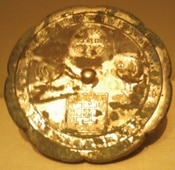 The 8-sided mirror was a design that was also common in China. This photo shows an 8-sided bronze mirror most likely from the Tang dynasty (some time before 800 AD). In China, as in Japan, such mirrors were often more than just a grooming aid. The inscriptions on the rim, in this example, indicate possible ritual usage by Daoist priests. The circle at the top represents heaven, while the square below represents earth. This mirror is on display at the Freer Gallery of Art in Washington DC. The 8-sided mirror was a design that was also common in China. This photo shows an 8-sided bronze mirror most likely from the Tang dynasty (some time before 800 AD). In China, as in Japan, such mirrors were often more than just a grooming aid. The inscriptions on the rim, in this example, indicate possible ritual usage by Daoist priests. The circle at the top represents heaven, while the square below represents earth. This mirror is on display at the Freer Gallery of Art in Washington DC. For more information see this article published in 1963: The Story of the Kodokan Badge by Senta Yamada.  “The serious Judo exponent trains every day.”
–Takahiko Ishikawa and Donn F. Draeger |